About Vladimir Zujovic — Psychologist & Gestalt Psychotherapist
Training & Qualifications
I hold a degree in Psychology from the University of Singidunum, Belgrade, and a Diploma in Gestalt Psychotherapy from EAPTI-SEB (Studio za edukaciju Beograd) — a European Accredited Psychotherapy Training Institute, accredited by both the European Association for Psychotherapy (EAP) and the European Association for Gestalt Therapy (EAGT).
The training comprised 2050 hours of professional practice across nine semesters, followed by a final qualification examination.
EAPTI-SEB is part of the EGN — the EAPTI-GPTIM Network — a transnational network of European Gestalt institutes operating under the academic oversight of the Gestalt Psychotherapy Training Institute Malta (EAPTI-GPTIM), a recognised Higher Education Institution accredited by the Malta Further & Higher Education Authority (MFHEA).
Since qualifying, I have worked over 10 years in private one-to-one practice with more than 1000 individuals. I work in English with clients across Europe, the UK, the US, Middle East and beyond.
I am a member of the Gestalt European Network (EGN) and engage in ongoing clinical supervision through EAPTI-SEB, Belgrade.
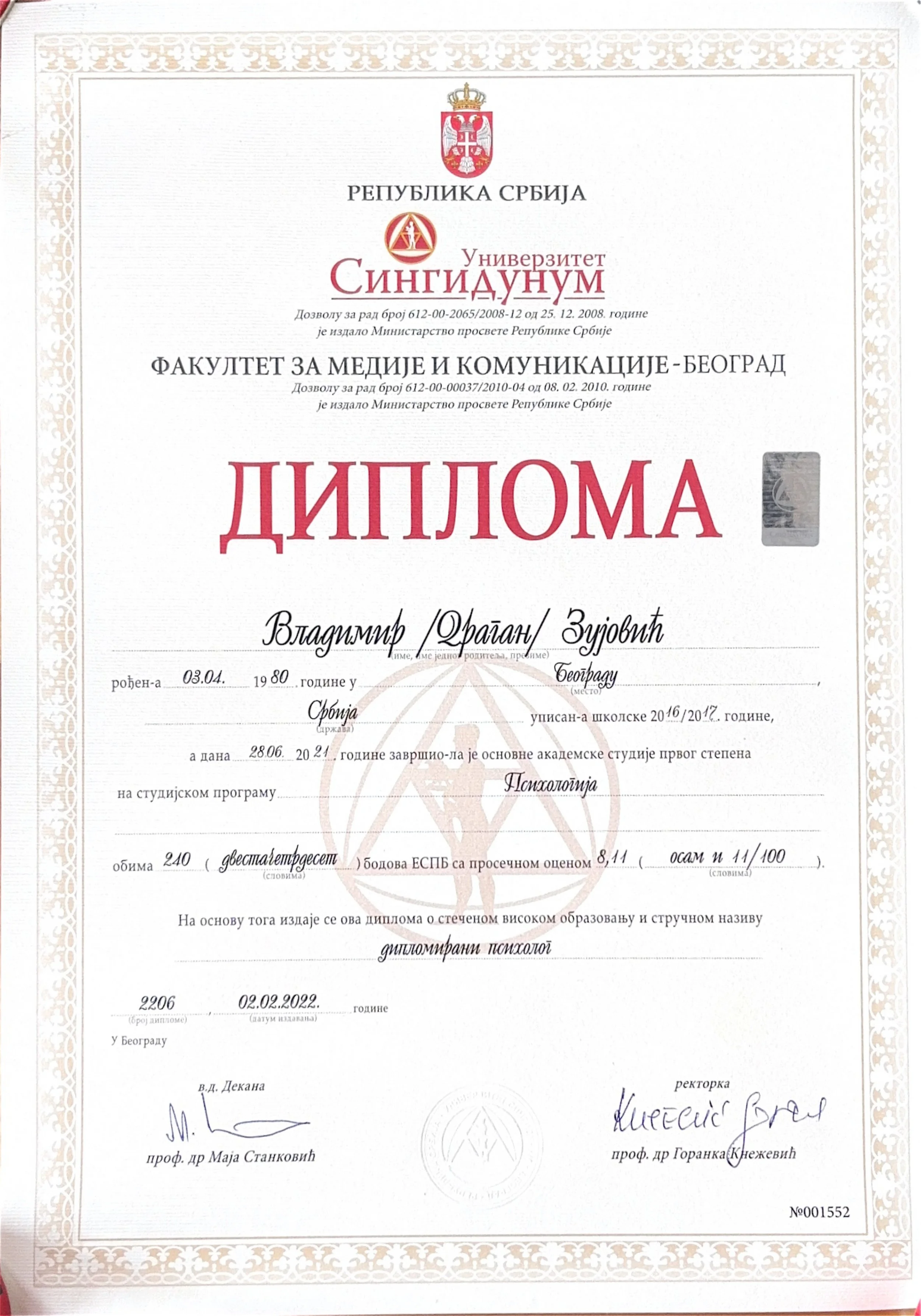
BSc in Psychology — University of Singidunum, Belgrade
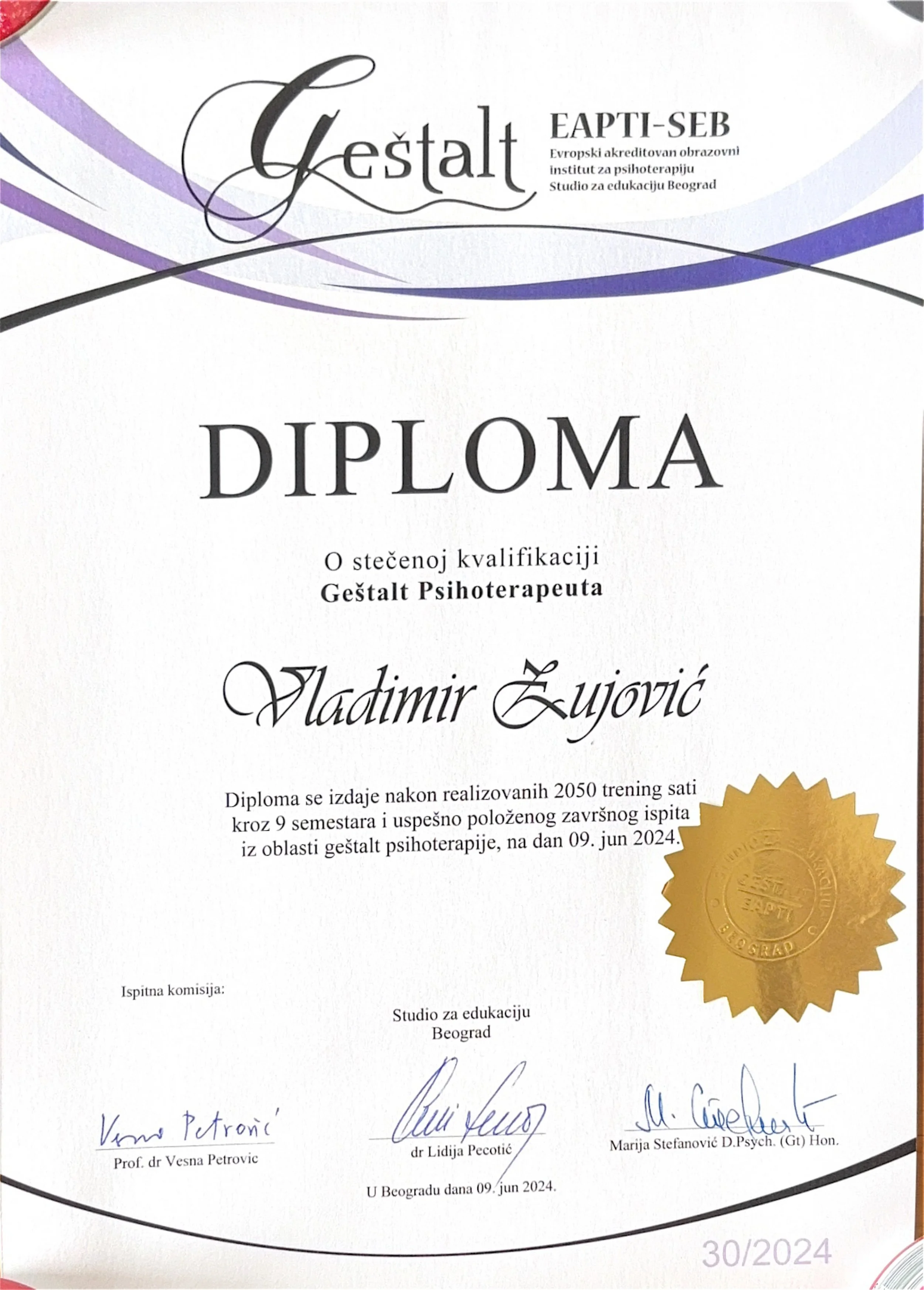
Diploma in Gestalt Psychotherapy — Gestalt EAPTI-SEB, 2050 training hours, 9 semesters
My Story
I know what it means to lose what was never really yours.
Not as a concept. Not from a book. From the inside — from years of living organized around performance, image, and the pressure to hold everything together.
I was born in Belgrade, Serbia, in 1980. My life has taken me through many worlds — sport, success, loss, ambition, family rupture, inner emptiness, love, fatherhood, and deep transformation.
I grew up in a time and environment that taught strength early. Some parts of my childhood were full of life, joy, and intensity. Other parts were marked by pain, confusion, and experiences that left a deep imprint. When my parents divorced, something in me broke open very young. From then on, like many people, I began learning how to survive by becoming strong, capable, and outwardly functional.
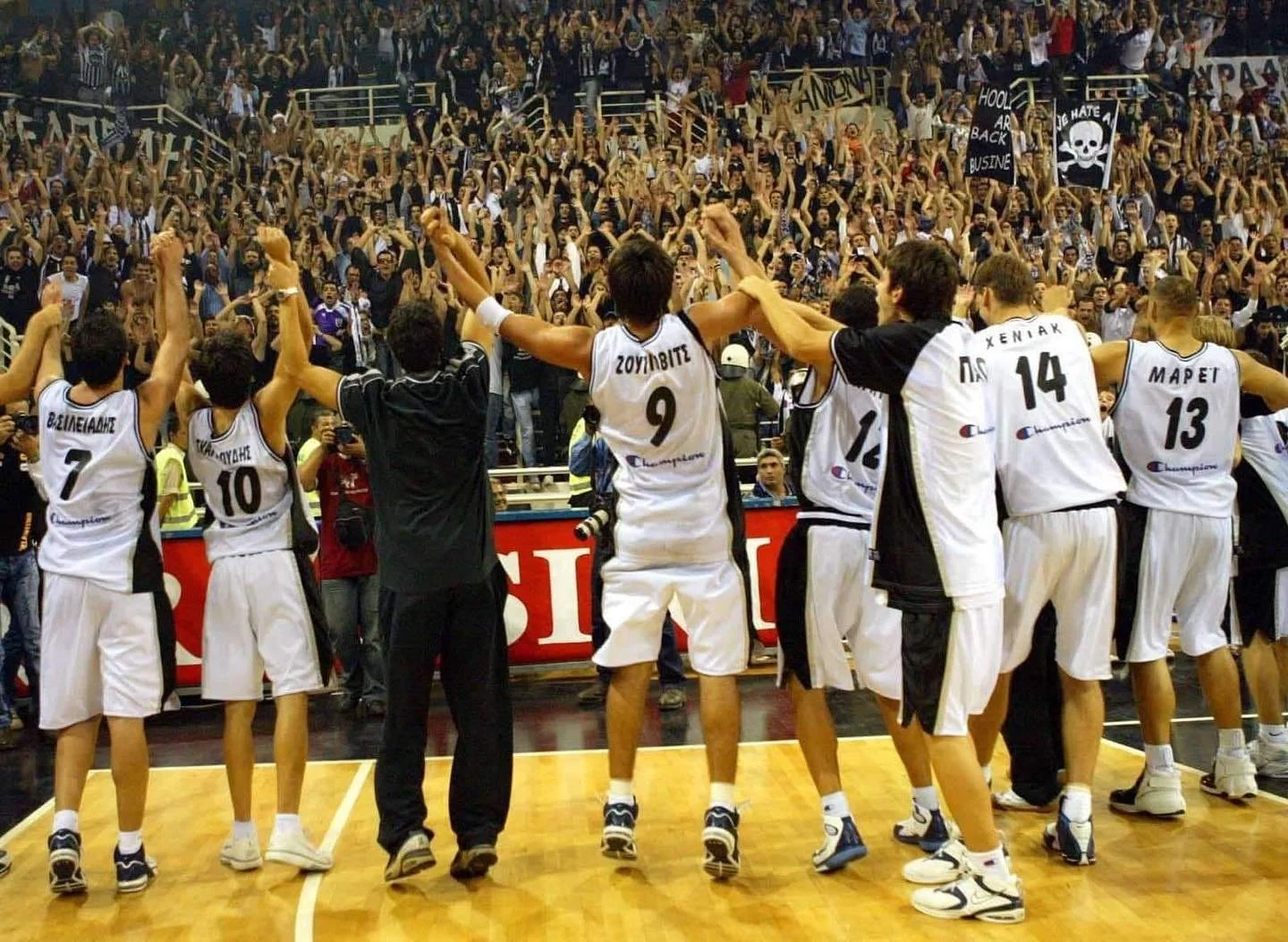
Basketball became my first great love. It gave me direction, discipline, and a way forward. It also became tied to something deeper: the need to prove my worth, to be seen, to succeed, and to feel that I mattered. At eighteen, I moved to the United States on a full basketball scholarship. Later, I went on to build a professional career in Europe, while also completing my studies in business and management.
From the outside, life looked successful. I was educated, accomplished, admired, and moving through the world with confidence. But inside, it was a different story. There was pain I had not yet met, grief I had not yet understood, and a profound sense of disconnection from myself. Relationships were difficult. Emotional closeness was difficult. Much of my life, though functional on the surface, was still organized around pressure, performance, and the hunger to feel whole.
After twelve years of professional basketball, I retired and returned to Belgrade. It was then that I could no longer ignore the distance between how life looked and how it actually felt. That was the beginning of a different path.
I began studying psychology and training in Gestalt psychotherapy. Around the same time, I entered marriage, became a father, and eventually went through a painful divorce. In that chapter of my life, many of my deepest wounds came fully into view. What followed was one of the hardest periods I have ever lived through: a fight for my daughter, a fight for truth, a fight for my right to remain a father, and a fight not to disappear inside suffering.
That journey changed me. Not quickly, not cleanly, and not through ideas alone. It changed me through grief, responsibility, courage, and years of inner work. Along the way, I completed my degree in psychology, qualified as a Gestalt psychotherapist, and, most importantly, became a man with a deeper relationship to truth, love, and presence.
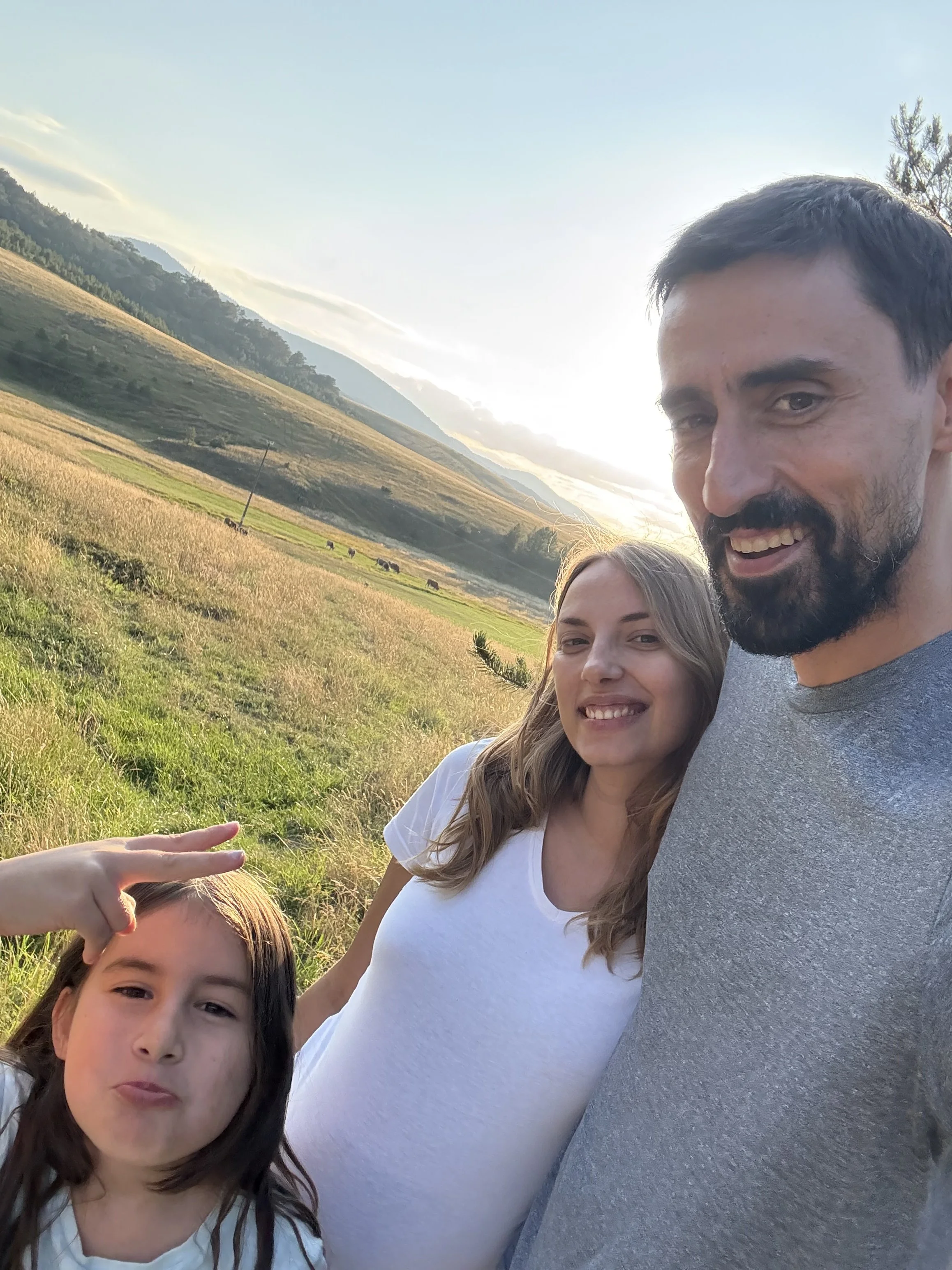
Today, I live a life that is very different from the one I once imagined. I am a father of two daughters. I also live in grounded, loving relationship that continues to teach me about honesty, presence and mutual care. I know the weight of responsibility, but I no longer believe that strength means self-abandonment. I know what it is to lose yourself in pressure, image, performance, and pain — and I also know that it is possible to come back.
#9 - Zujovic
This is why I work the way I work.
My work is not built on theory or technique alone. It is built on lived experience — a real encounter with what it means to break, to survive, and to become more honest than you ever thought you could be.
I am not interested in managing your pain from a careful distance. I have been inside mine. I know what it costs to keep performing when something inside you has already broken. And I know what becomes possible when you finally stop.
I destroy what is false in the name of what is real.
I know what that means — because I have lived it.
Begin here
If something in what you’ve read feels familiar - or if you simply want to understand whether this work is right for you - you’re welcome to request a consultation.